What Is AI Literacy? The AI Basics Every Coding Beginner Needs First
What separates people who use AI well from everyone else is not prompt tricks. It is the habit of doubting and verifying what AI gives back.

AI literacy is the ability to sense what AI is good and bad at, and to doubt and verify what it hands back before you trust it. For someone just learning to code, this matters even more than syntax.
The reason is simple. Anyone can ask AI for code now, but only people with the basics can tell whether that code is right. You already know this from reading: someone who cannot read gets fooled by a convincing lie, and someone who cannot read AI's output gets fooled by convincing but broken code. AI literacy is the reading comprehension for that output.
Below we define what AI literacy actually is, cover the four basics a coding beginner needs first, then look at the moment two people get the same AI answer and end up in very different places, plus how to build the skill while you learn.
What AI literacy actually means
Literacy originally means the ability to read and write. AI literacy extends that to a new tool: the ability to read and write AI. It is not "I have used ChatGPT before." It is understanding how AI produces an answer, knowing its limits, and taking the result critically so you can bend it to your goal.
The key is the gap between "can use it" and "can direct it." Typing a question into a search box is one skill; judging which results to trust is another. AI is dangerous here because it answers so smoothly that a wrong answer looks exactly as confident as a right one. Not falling for that polish is half of literacy.
This matters more for coding beginners than for most people. In writing, a wrong AI sentence is just awkward. In code, a wrong answer runs quietly and then breaks in one specific situation. The demo passes, and the incident happens later, in front of real users. So the habit of pushing past "it runs" to "is it right" needs to start at the beginner stage.
The four AI basics every beginner needs
You do not need grand theory. Four working instincts, used constantly while you learn, are enough.
| Basic | One-line definition | Why it matters when you are learning |
|---|---|---|
| Sense of how it works | AI does not know the answer; it continues the most probable next words | Knowing it is not a guarantee keeps you from blind trust |
| Spotting hallucinations | It invents functions and facts that do not exist, confidently | You build the habit of running it first to check |
| Context and limits | It cannot fill in context you never gave, and forgets earlier turns | You learn to feed it exactly the information it needs |
| Asking and verifying | You decide what to request and judge whether the result is correct | You stop copying wrong answers verbatim |
These four are not separate facts but one loop. Understanding how AI builds an answer makes you doubt it; doubting makes you verify; verifying means you have to read what you asked for and what came back. It loops right back to the basic skill of reading code.
Where literacy splits: same AI answer, different outcome
That sounds abstract, so here is a common scene. You want to remove duplicates from a Python list, you ask AI, and you get this back.
numbers = [1, 2, 2, 3, 3, 3]

# what AI suggested
result = numbers.remove_duplicates()
print(result)
The explanation sounds reasonable and the code looks clean. The catch is that Python lists have no remove_duplicates() method at all. AI invented a plausible name. That is a hallucination.
Low literacy means pasting this in, hitting an AttributeError, and flailing for a while. Literacy means doing two things. You run it once, and when it errors you either ask the AI "does that method actually exist?" or check for yourself. Then you find the real way to do it.
numbers = [1, 2, 2, 3, 3, 3]

# what actually works
result = list(set(numbers))
print(result)  # [1, 2, 3]
The difference was not a clever prompt. It was the habit of doubting the answer and running it yourself. Given the same reply, the person who verifies moves on in five minutes while the person who trusts it loses time in the wrong place. Being able to read code makes that check much faster too. For the bigger picture on what stays a human's job, Should you still learn to code in the AI era? picks up that thread.
How to build AI literacy while you learn
The best drill is solving the same problem twice. Solve it yourself first, ask AI to solve the same thing, then read the two versions side by side. Where they differ, ask "why did you do it this way?" line by line. That one comparison teaches your eye faster than ten vague prompt-engineering lectures.
For that you need the minimum skeleton to read code: variables, loops, conditionals, functions, written out by hand until they stick, so AI's code becomes legible to you. The Python basics course is a good place to build that skeleton by running it straight in the browser. To practice shaping requests and checking the answers, the AI prompt engineering course helps, and the AI fundamentals course gives you the big picture of how AI works underneath.
If you want to build literacy from the concepts up, the AI literacy course covers how AI works, where it fails, and how to use it well at a beginner's level. Either way the point is the same: not switching AI off and memorizing, but repeating the loop of leaving AI on and verifying its answers.
What to do today
You do not need a grand start. Today, finish one small piece of code end to end on your own. Then ask AI to do the same thing, compare it against yours, pick one line you do not understand, and ask "why is this line needed?" Repeat just those three steps and a verifying eye starts to form.
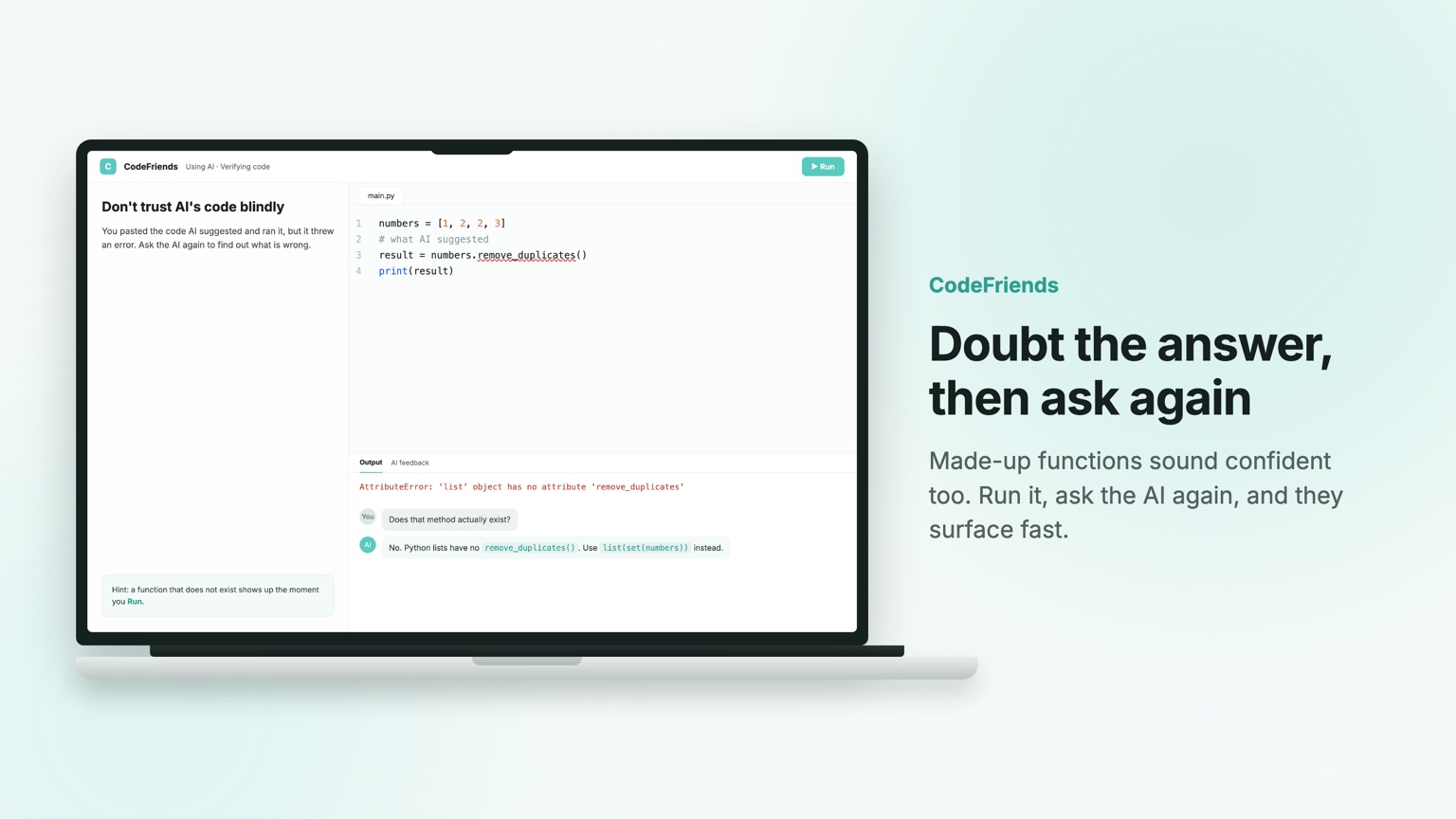
CodeFriends is built to run code in the browser with no setup and give live AI feedback when you get stuck. Running the code AI gave you right there and asking why it works is the core verifying loop of AI literacy, so we built around it. If you are still picking a first language, start with Python vs JavaScript: your first programming language.
Frequently asked questions
Is AI literacy just the skill of writing good prompts?
Writing prompts is only part of it. The bigger half is doubting and verifying what AI returns. No matter how good your request is, if you cannot judge whether the code is correct, you will copy wrong answers verbatim. A good request and a cold check go together.
Can I build AI literacy without knowing how to code?
It grows alongside the basics. To tell whether AI's code is right, you have to be able to read code, so it helps to learn the minimum (variables, loops, conditionals, functions) yourself first. On top of that, repeating the habit of verifying AI's answers raises your literacy quickly.
How do I spot an AI hallucination?
The surest way is to run it. For code, execute it and watch for errors, and check whether it used a function or library that does not exist against the official docs. If an answer is unusually smooth and specific but the source is unclear, doubt it once more. That habit of doubting and checking is the best filter for hallucinations.