Python vs JavaScript: Which Should Be Your First Programming Language (2026)
The answer depends on your goal. Here is the 30-second version first.

Plenty of people lose days just picking a first language. Every blog says something different, and the comments are always fighting about it.
The answer is simple. Both are good first languages. It comes down to one thing: what do you want to build? Data, AI, or automation, go with Python. Websites and apps you can see and click, go with JavaScript. And honestly, the time you spend deciding is the most wasted part.
Below you will see the two side by side in code, then get career-based picks and a plan for getting through the first month.
Side by side, in code
Here is the same task, "print 1 to 5," in each language.
# Python
for i in range(1, 6):
    print(i)
// JavaScript
for (let i = 1; i <= 5; i++) {
  console.log(i);
}
Python reads almost like an English sentence. JavaScript has more brackets, a semicolon, and that i++. You get comfortable with both in a few days, but that texture is what makes week one feel hard or easy.
Where they run differs too. JavaScript is the only language that runs straight in the browser, so a few lines move the screen. Python is strong at calculating and tidying data, and in AI and automation the courses, libraries, and job posts mostly run on it.
Keeping only the things that actually affect a first-language choice:
| Criteria | Python | JavaScript |
|---|---|---|
| Syntax difficulty | Very easy, reads close to English | Easy, but async concepts can trip you up |
| Main fields | Data, AI/ML, automation, backend | Web frontend, apps, backend (Node.js) |
| First result | A calculator or data script | A working web page |
| Where it runs | Separate install or a browser tool | Runs in any browser instantly |
| Job market | Strong in data and AI roles | The largest volume of web dev postings |
The table makes you want to pick a winner, but the real point sits under it. Variables, loops, conditionals, functions. That skeleton, already in the code above, is shared by both. Learn one well and the other is mostly a syntax swap. Your first pick is not a language for life. It is the entrance where you will have fun fastest.
Who Python fits
Your first Python program is usually unglamorous. Renaming a folder full of files, or summing a column from a spreadsheet. The screen stays plain. That plainness is the strength. With no decoration code in the way, all that is left is the feeling that the computer does exactly what you told it.
If data analysis, statistics, or automation pulls at you, Python is close to the right call. The AI and machine learning everyone is curious about run almost entirely on it. If you are an office worker buried in repetitive spreadsheet work, you will be muttering "I should have learned this sooner" by the end of week one. To start from the basics, run the code above in the Python fundamentals course.
Who JavaScript fits
JavaScript's weapon is instant reaction. No install. Open a browser and a few lines click a button or change a color. For anyone who only stays motivated when results are visible, that one trait is the fuel that gets you to the finish. If I am honest, judging purely by who actually sticks with it, the visible payoff gives JavaScript a small edge.
There is a trap, though. Concepts like asynchronous code will make a beginner's head hurt at least once. You do not need to dig into that early. Enjoy moving the screen first, and meet the hard parts when you actually hit them. If you want to build for the web, the web development course is a good starting line.
The hard part isn't the language, it's month one
Which language you chose barely matters a month later. Whether you quit or not is the whole game, and the early walls look the same in either language.
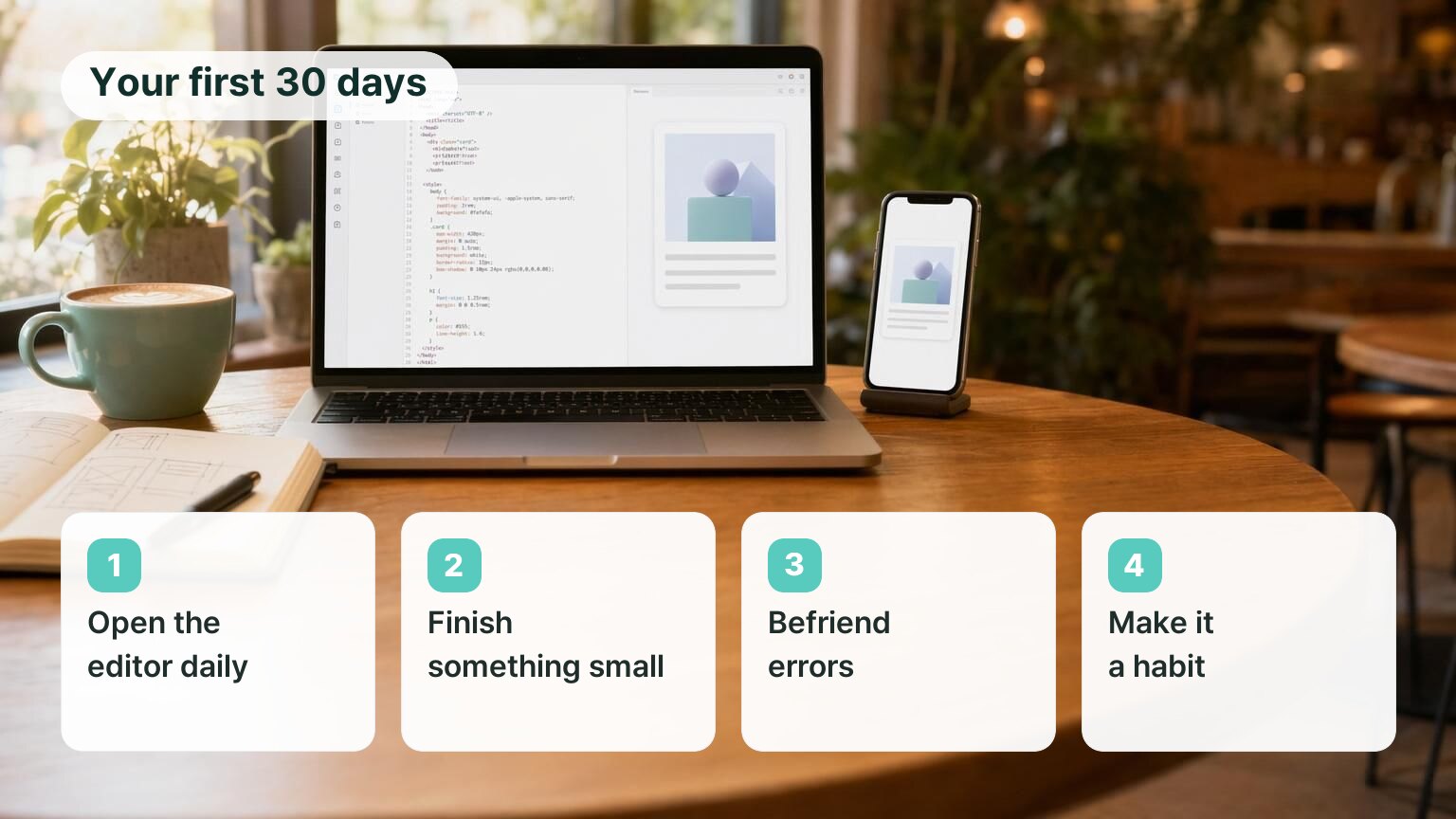
Week one has one goal: open the editor every day. Forget skill. If installation stops you, you burn out before you start, so a browser-based environment that runs instantly removes that step. Week two, finish one small thing end to end. The number of things you finish becomes your confidence. Week three, you will get stuck, and getting stuck is the learning. Read the error and change one thing at a time. By week four, "I should study" turns into "I am someone who writes code daily," and from there the routine runs itself. The concrete way to survive those four weeks is in a 4-week routine that beats the motivation slump.
If you already know your direction
A clear goal makes the pick easy. Data analysis or AI engineering, Python is basically the entry ticket. Web or frontend, you will touch JavaScript every day. Backend uses both, so Python (Django, FastAPI) or JavaScript (Node.js) are both fine. No direction yet? Build your thinking with Python, then switch to JavaScript when you start craving visible results.
Still can't decide?
Type out the two for loops above, five minutes each. Whichever feels better under your fingers, whichever result you are happier to see, that is your language. The concepts are the same anyway, so switching later costs almost nothing.
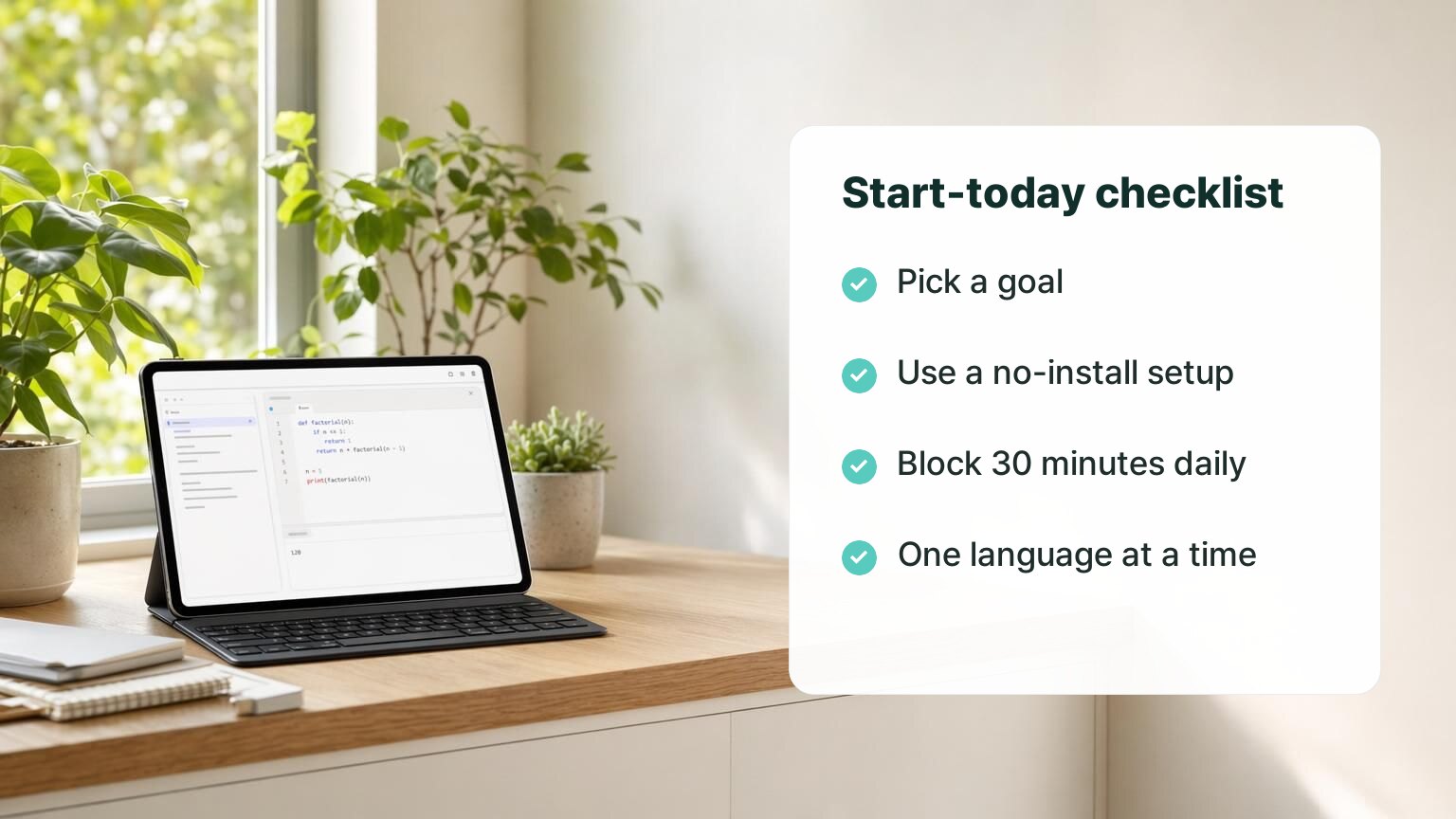
CodeFriends runs Python and JavaScript right in the browser with no setup, and gives real-time AI feedback when you get stuck. It is built to cut the friction of that first month, so stop deliberating and run your first line today.
Frequently asked questions
Is Python really easier than JavaScript?
By syntax alone, Python is more intuitive, so the early ramp is gentler. But JavaScript shows results on screen immediately, which helps you stay motivated. If "easy" means syntax, Python wins. If it means fun and instant feedback, JavaScript can feel easier.
Will I regret it later if I pick the wrong first language?
Almost never. Core concepts like variables, loops, conditionals, and functions are shared, so learning one sharply reduces the time to learn the other. What matters is finishing one project end to end, not the initial choice.
Can I learn both at the same time?
Not at first. Studying two languages in parallel as a beginner blends the syntax and creates confusion. It is far more efficient to finish one small project in a single language, then move to the second.